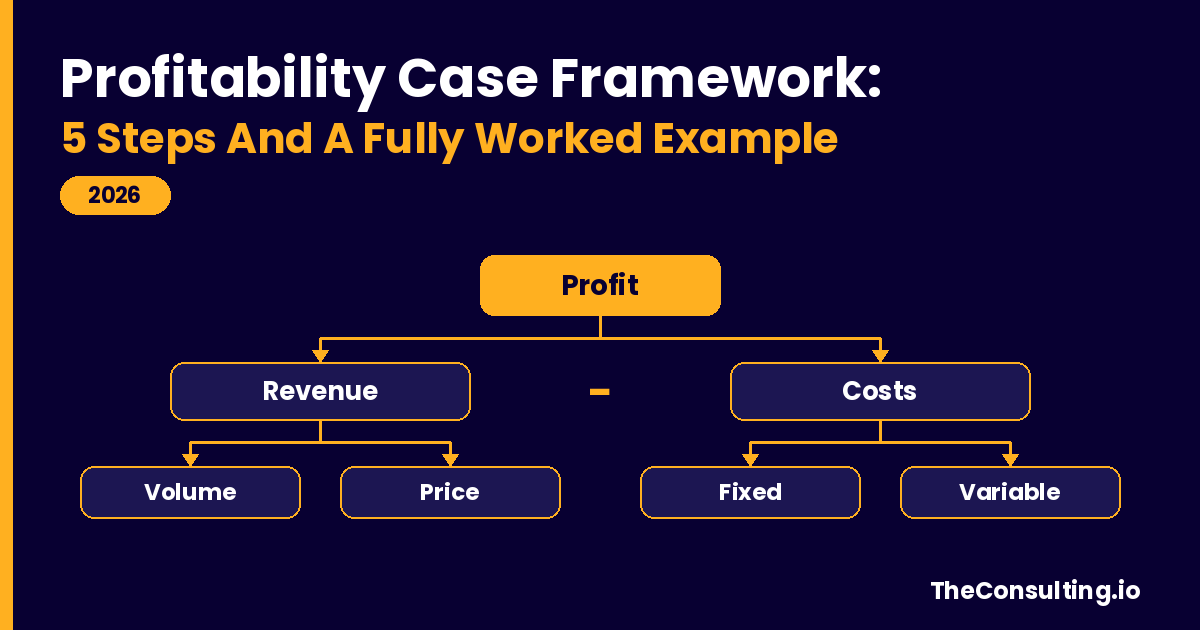
"Our client's profits have fallen over the last two years. Why, and what should they do?" Some version of this opens more consulting interviews than any other prompt, which makes it the one case you cannot afford to fumble. The good news is that profit only has two moving parts: what comes in and what goes out. A profitability case is a search for which one moved, which piece of it moved, and why. This guide walks you through the framework, then plays out a complete case the way it would unfold in a real interview, interviewer lines included.
The profit tree
Everything starts from one line:
Profit = Revenue − Costs
Then you split each side until you reach things that can be measured:
- Revenue = Volume × Price
- Volume: number of customers × units each customer buys
- Price: list price, discounts, product mix
- Split by product line, customer segment, region or channel when there's more than one
- Costs = Fixed costs + Variable costs
- Fixed: rent, salaried staff, equipment, overheads. These don't change with volume.
- Variable: materials, commissions, delivery, transaction fees. These rise with every unit sold.
That's the whole framework. The skill isn't memorising it. The skill is moving through it quickly and knowing where to dig deeper.
The 5 steps
1. Clarify the goal and the timeframe. How much have profits fallen, over what period, and what does the client want: back to the old level, or a specific target?
2. Ask whether it's the company or the market. Are competitors seeing the same decline? If the whole industry is down, the cause is outside the company (demand, regulation, a new substitute). If it's only your client, the cause is inside.
3. Split profit into revenue and costs, and find which side moved. Ask for the numbers for both years. Don't explore both sides equally. Let the data tell you where to go.
4. Drill into the side that moved. Go one level down at a time. Revenue fell? Is it volume or price? Price fell? Is it discounts or mix? Keep going until you find something specific enough to act on.
5. Recommend. Lead with the answer, give two or three supporting reasons with numbers, state the risks, and suggest next steps.
A full worked case: FitLine Gyms
Here's how the case plays out in an interview. Read the candidate lines as a model of how to talk, not just what to calculate.
Interviewer: Our client, FitLine, runs 40 gyms across the US Midwest. Profit has dropped from $12 million to $7 million in two years. They want to know why and how to fix it.
Candidate: Before I structure this, can I confirm a couple of things? Is the $12 million to $7 million drop operating profit? And are other gym chains in the region seeing the same decline?
Interviewer: Yes, operating profit. Competitors are roughly flat.
Candidate: So this looks like a FitLine-specific problem rather than a market one. I'll split profit into revenue and costs and see which side moved. Do we have both for the two years?
The data:
| Two years ago | This year | Change | |
|---|---|---|---|
| Membership revenue | $60.0M | $56.2M | −$3.8M |
| Personal training revenue | $10.0M | $10.0M | — |
| Total revenue | $70.0M | $66.2M | −$3.8M |
| Total costs | $58.0M | $59.2M | +$1.2M |
| Profit | $12.0M | $7.0M | −$5.0M |
Candidate: Of the $5 million drop, $3.8 million comes from revenue and $1.2 million from costs. So revenue is about three-quarters of the problem, and all of it comes from memberships. I'll start there. Membership revenue is members times average fee. How have those moved?
Interviewer: Members went from 100,000 to 104,000. The average annual fee went from $600 to $540.
Candidate: So volume is actually up 4%, but price per member is down 10%. Price is the issue, not demand. Did something change in pricing, a new plan, more discounting?
Interviewer: Eighteen months ago FitLine launched an Off-Peak plan at $340 a year, usable before 4 p.m. on weekdays.
Candidate: Then I want to know who took it, new members or existing ones switching down. Do we know the split?
Interviewer: 24,000 members are now on Off-Peak. Full-price members fell from 100,000 to 80,000.
Candidate: That tells the story. Full-price fell by 20,000 and Off-Peak gained 24,000, so roughly 20,000 existing members switched down and only about 4,000 were new.
The switchers each pay $260 less: 20,000 × $260 = $5.2 million lost. The new members bring in 4,000 × $340 = $1.36 million gained. Net: −$3.84 million, which matches the drop in membership revenue.
The Off-Peak plan was meant to bring in new customers, but it mostly gave a discount to people who were already paying full price.
Interviewer: Good. What about the $1.2 million cost increase?
Candidate: I'd split it into fixed and variable. Since membership only rose 4%, I'd expect fixed costs like rent or staffing to be the driver rather than variable costs.
Interviewer: Correct. Rent renewals at eight locations added about $1 million.
Candidate: So my recommendation is this.
The main cause is the Off-Peak plan. It cannibalised full-price memberships and cost about $3.8 million a year in revenue. The secondary cause is rent increases, about $1 million.
First, close Off-Peak to existing members, or make switching less attractive by narrowing the hours or adding a minimum-term rule. If even half of the switchers moved back, that recovers about $2.6 million. Second, keep Off-Peak for genuinely new customers, since it does attract some. Third, review the eight locations with new leases and renegotiate or consolidate the weakest ones.
The risk is that some switchers cancel entirely instead of moving back, so I'd test the change at a few gyms first.
Why this answer works
Every question was earned by the previous answer. The candidate never asked for everything at once. Each number pointed to the next question.
The maths closed the loop. The −$3.84 million from switching matched the revenue drop exactly. That's how you know you've found the real cause, not just a contributing one.
The recommendation was quantified and had a risk attached. "Recover about $2.6 million, test it first" sounds like a consultant. "They should fix their pricing" doesn't.
Where candidates go wrong
Going through the whole tree mechanically. Asking about every cost line when revenue is clearly the issue wastes time and signals you aren't prioritising.
Stopping at "revenue fell". That's a symptom. The interviewer wants the specific cause: a plan, a segment, a channel, a contract.
Ignoring the market check. If competitors are struggling too, the answer is completely different, and you'll have spent ten minutes on the wrong branch.
Mixing up fixed and variable costs. Rent doesn't go up because you sold more memberships. Know which costs scale with volume.
Practise until it's automatic
The framework fits on a napkin. What takes practice is running it live: picking the right branch, doing the maths while talking, and turning numbers into a recommendation under time pressure.
Build the structuring habit with Structure Drills, work through full profitability problems in Prep Cases, and run a live case with a partner in a Peer-to-Peer Session.
Could you crack FitLine in under 20 minutes? Put it to the test with TheConsulting.io's Prep Cases, or see the plans.