
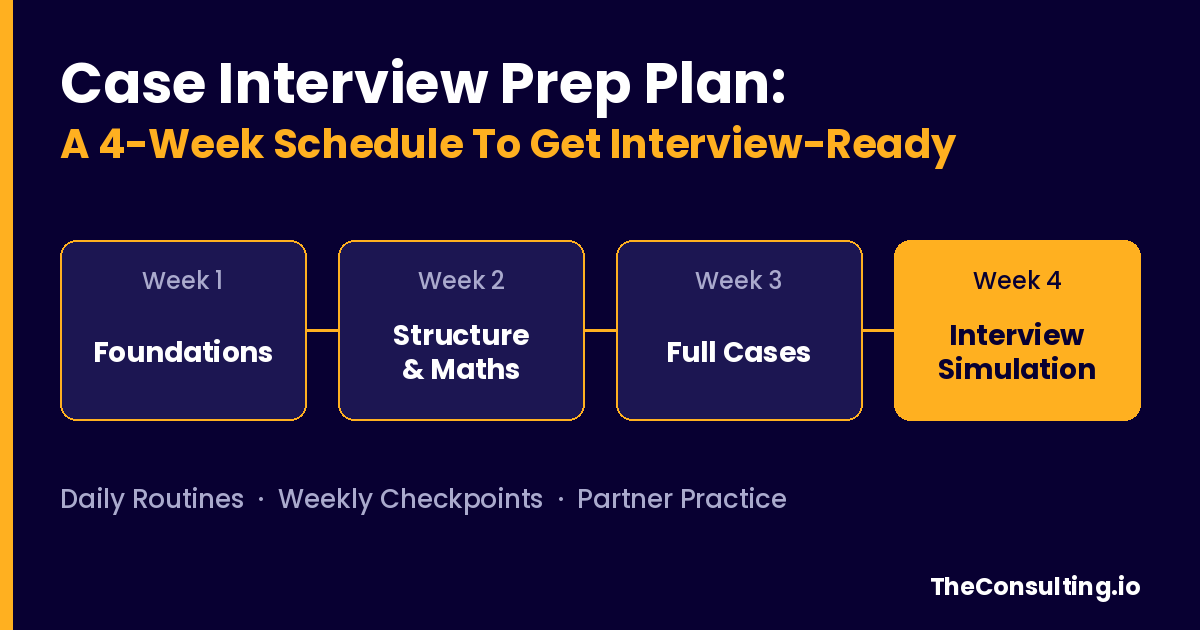
Most people preparing for consulting interviews don't fail from lack of effort. They fail from effort spent in the wrong order: weeks of reading frameworks without ever saying a case out loud, or jumping into live practice before they can do the maths without freezing. Four focused weeks is enough to become genuinely interview-ready if each week builds on the one before it. The plan below sets out what to do each week, how to structure each day, and the checkpoints that tell you whether you're ready to move on. It assumes about 90 minutes on weekdays and a longer session at weekends, and it works whether you're a student, a working professional or switching in from another field.
The plan at a glance
| Week | Focus | By the end you can… |
|---|---|---|
| 1 | Foundations | Explain the main case types and solve simple guesstimates out loud |
| 2 | Structure and maths | Build a clear structure for any prompt in under 2 minutes and calculate without freezing |
| 3 | Full cases | Run complete cases from opening to recommendation, alone and with a partner |
| 4 | Interview simulation | Perform under realistic pressure, including fit questions, and fix your last weak spots |
Week 1: Foundations
Goal: understand what a case interview is testing and get comfortable speaking your reasoning.
Daily routine (about 90 minutes):
| Time | Activity |
|---|---|
| 30 min | Learn one case type: profitability, market entry, pricing, growth, M&A, cost reduction, market sizing or operations |
| 30 min | Solve one guesstimate out loud with a timer, then check your logic |
| 20 min | Mental maths: one short timed set |
| 10 min | Note the business terms you didn't know and look them up |
Weekend: watch or read two complete example cases from start to finish, and notice how the candidate opens, structures, and closes.
Checkpoint before moving on: Can you name the main case types and say what question each one is really asking? Can you finish a guesstimate in under 8 minutes while talking the whole time? If not, repeat the guesstimate practice for two or three more days. Everything later depends on being comfortable talking through numbers.
Week 2: Structure and maths
Goal: make structuring and calculating fast enough that they stop using up your attention.
Daily routine:
| Time | Activity |
|---|---|
| 40 min | Structure drills: read five case prompts and build an issue tree for each in under 2 minutes |
| 30 min | Calculation practice: percentages, large numbers, breakeven, growth |
| 20 min | Chart reading: pull the main insight from three charts or tables in under a minute each |
How to practise structuring: For each prompt, write the structure, then ask yourself whether the branches overlap and whether anything is missing. If two branches could hold the same idea, or a likely cause has nowhere to go, rebuild the tree. This is what interviewers mean by "MECE": mutually exclusive, collectively exhaustive.
Weekend: your first full case with a partner. It will feel clumsy, and that's normal. The goal is just to find out what breaks under pressure.
Checkpoint: Can you produce a clear, tailored structure in under 2 minutes for most prompts? Do you get calculations right at least 8 times out of 10? If maths is still slowing you down, keep a 20-minute daily calculation block into Week 3.
Week 3: Full cases
Goal: connect everything into complete cases and build stamina.
Daily routine:
| Time | Activity |
|---|---|
| 45–60 min | One full case: solo on most days, with a partner on at least two |
| 20 min | Review: write down where you hesitated, what you missed, and what you'd do differently |
| 10 min | Keep-sharp maths |
Partner practice is where most improvement happens. Reading cases builds knowledge. Being interviewed builds performance. Swap roles too: interviewing someone else shows you very quickly what a clear answer sounds like and what a confusing one sounds like.
Mix the case types. Don't do three profitability cases in a row. Real interviews don't tell you the type in advance, and recognising it is part of the test.
Weekend: two full cases with different partners, then compare the feedback. The comments that come up twice are your priorities for Week 4.
Checkpoint: Can you finish a full case in 25–30 minutes with a clear recommendation backed by numbers? Have you done at least six full cases, three or more with a partner?
Week 4: Interview simulation
Goal: perform under realistic conditions and close the remaining gaps.
Daily routine:
| Time | Activity |
|---|---|
| 45 min | One full case in mock-interview conditions: camera on, timed, no notes beyond paper |
| 30 min | Targeted practice on your top weakness from Week 3 feedback |
| 15 min | Fit and behavioural questions: rehearse your stories out loud |
Prepare your fit stories. Most consulting interviews pair a case with personal questions: why consulting, why this firm, a time you led a team, a time you failed. Prepare four or five short stories you can adapt, each with a clear situation, your actions and the result.
Ease off before the interview. In the final two days, do one light case and some maths to stay warm, then rest. Last-minute cramming makes you more tired, not more ready.
Checkpoint: Can you handle an unfamiliar case type calmly? Do your fit stories come out naturally rather than sounding memorised?
If you have less than four weeks
Two weeks: combine Weeks 1 and 2 into one week, with two cases a day in the second week, and get partner practice from day 5.
One week: skip theory beyond a quick look at the main case types. Do one guesstimate, one structure drill and one full case every day, at least four of them with a partner. Focus on the most common case types: profitability, market entry and market sizing.
If you have more than four weeks
Use the extra time for volume and variety: more partner cases, firm-specific practice (some firms run interviewer-led cases, others candidate-led), and cases in industries you know least. Most candidates who reach top-firm offers have done somewhere between 30 and 50 full cases.
Track your progress
A simple log keeps you honest. After every full case, rate yourself 1–5 on:
- Structure: clear, tailored, MECE?
- Maths: fast and accurate?
- Insight: did you explain what the numbers meant?
- Communication: clear, confident, easy to follow?
- Recommendation: specific, backed by numbers, with risks?
When your average is above 4 across your last five cases, you're ready.
Follow the plan on TheConsulting.io
Each week of this plan maps onto practice tools: Drills for guesstimates, structure and calculations in Weeks 1 and 2, Prep Cases for full solo cases in Weeks 3 and 4, and Peer-to-Peer Sessions for the partner practice that makes the biggest difference.
Interview in four weeks? Start Week 1 today with TheConsulting.io's Drills, or see the plans.


