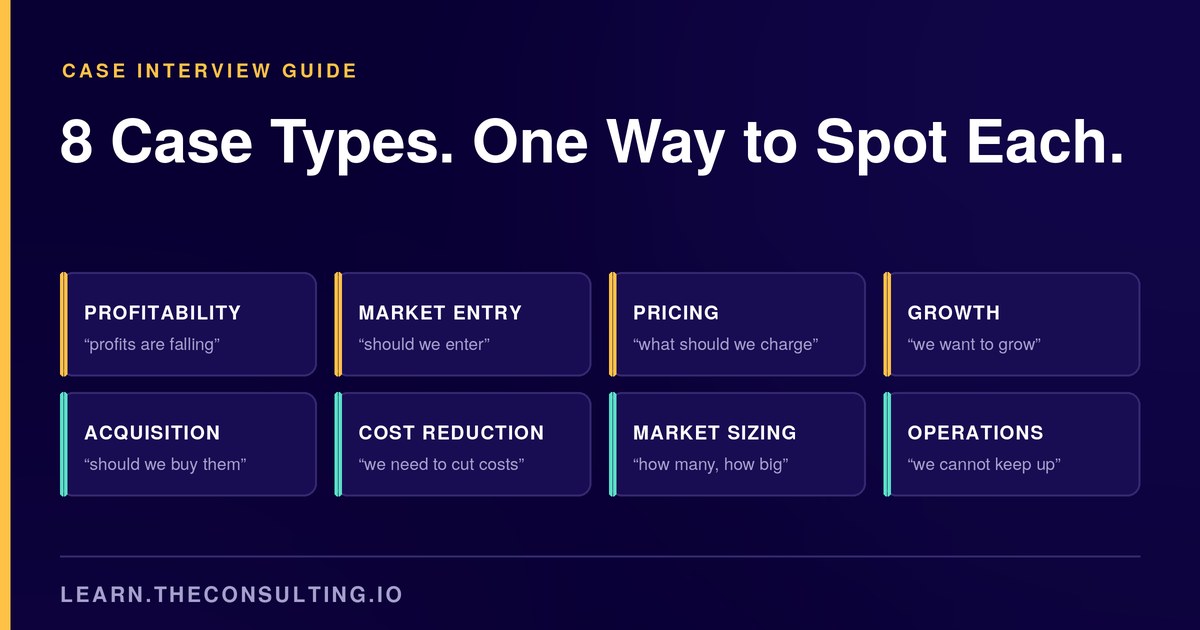
Most of the panic in a case interview happens in the first thirty seconds, when the interviewer finishes reading the prompt and you have no idea what kind of problem you are holding. That moment is easier than it looks, because consulting cases are not infinitely varied almost every one belongs to one of eight recognisable types, and each type announces itself in the opening sentence if you know the words to listen for. This guide covers all eight, the giveaway phrase for each, and the structure that solves it.
Why spotting the type matters
Picking the right structure in the first minute buys you the whole rest of the case. Pick the wrong one and you spend ten minutes analysing something nobody asked about, which is usually unrecoverable.
One warning before the list. Knowing the eight types is useful. Reciting a memorised framework is not. Interviewers can tell instantly, and it reads as someone who has studied cases rather than someone who can think. Use these as starting points you adapt out loud, not scripts you recite.
The 8 types
1. Profitability
You will hear: "Our client's profits have fallen." "Margins are declining." "Revenue is up but we are making less money."
The structure: Profit equals revenue minus costs. Split revenue into volume and price. Split costs into fixed and variable. Find the branch that moved, then quantify how much of the gap it explains.
The trap: Looking at total costs instead of cost per unit. Total costs rising alongside volume is normal. Contribution per unit falling is the finding.
How common: The single most common type. Expect at least one.
2. Market entry
You will hear: "Should our client enter this market?" "They are considering launching in a new country." "Is this new segment worth going after?"
The structure: Four questions in order. Is the market worth entering, can the client win, should they be the one doing it, and how should they enter.
The trap: Listing factors instead of deciding. You have to end with a clear go or no-go.
How common: Second most common.
3. Pricing
You will hear: "What should they charge?" "How should we price this new product?" "Are we leaving money on the table?"
The structure: Three approaches. Cost-based gives you a floor. Competitor-based gives you an anchor. Value-based gives you the answer. Work through all three, then say which decides the number.
The trap: Answering with cost-based pricing. It is the easiest number to reach and almost always the weakest.
How common: Regular, both as a full case and as a step inside other cases.
4. Growth strategy
You will hear: "Our client wants to double revenue." "Growth has stalled." "Where should they look for their next source of growth?"
The structure: Four routes to growth. Sell more to existing customers, win new customers in the current market, launch new products, or move into new markets. Size each one roughly, then rank them by return and difficulty.
The trap: Jumping straight to new markets because it feels ambitious. Selling more to existing customers is usually cheaper and faster, and saying so shows commercial judgement.
How common: Frequent, and often blended with market entry.
5. Acquisition or merger
You will hear: "Should our client buy this company?" "Is this acquisition a good idea?" "What would you pay for it?"
The structure: Is the target attractive on its own, what does it add that the client cannot build, what is it worth, and what happens after the deal closes.
The trap: Forgetting integration. Most deals that fail, fail after signing. Raising this unprompted marks you out.
How common: Occasional, and more likely at later rounds.
6. Cost reduction
You will hear: "Costs have grown faster than revenue." "We need to take 20% out of the cost base." "Where can the client save money?"
The structure: Break costs into fixed and variable, then into their largest components. Benchmark against competitors where you can. Attack the biggest lines first, and separate cuts that are easy from cuts that damage the business.
The trap: Recommending cuts that reduce the thing driving revenue. Always say what the cut might break.
How common: Regular, and often hiding inside a profitability case.
7. Market sizing
You will hear: "How many of these are sold each year?" "How big is this market?" "Estimate the number of..."
The structure: Break the number into smaller ones you can reason about. Go top-down from a population, or bottom-up from a single unit. Use round numbers. Sense-check the answer before you say it.
The trap: Going quiet while you calculate. The reasoning is the thing being assessed, so it has to be audible.
How common: Very common, usually as one step inside a larger case rather than the whole case.
8. Operations and capacity
You will hear: "Deliveries are running late." "The factory cannot keep up with demand." "How many staff do they need?"
The structure: Follow the process end to end and find the bottleneck. Compare capacity against demand. Then decide whether to add capacity or reduce the demand hitting the constraint.
The trap: Adding capacity everywhere. Only the bottleneck limits throughput, and spending anywhere else changes nothing.
How common: Less frequent, but more likely at operations-focused firms.
How to tell them apart quickly
The opening prompt almost always gives it away.
| What you hear | What it is |
|---|---|
| Profits are down | Profitability |
| Should we enter | Market entry |
| What should we charge | Pricing |
| We want to grow | Growth strategy |
| Should we buy them | Acquisition |
| We need to cut costs | Cost reduction |
| How many, how big | Market sizing |
| We cannot keep up | Operations |
One caution. Real cases mix types. A market entry case will usually contain a market sizing step and often a pricing one. An acquisition case will contain a profitability analysis of the target. Identify the main question, then recognise the smaller ones as they arrive.
What interviewers are actually assessing
Across all eight types, the same four things are being scored.
Structure can you break a messy problem into clean, non-overlapping pieces.
Prioritisation can you choose the two branches worth testing and say why, rather than working through all nine.
Numbers can you calculate accurately and quickly while talking.
Judgement does your recommendation sound like it came from someone who understands businesses, including what might go wrong with it.
Notice that none of those is "did you recall the right framework."
Where to start
If you are early in your preparation, do not try to cover all eight at once.
Learn profitability first. It is the most common type and its logic shows up inside most of the others. Then market entry, then pricing. Those three cover the large majority of what you will actually be asked. The remaining five are quicker to pick up once the first three are solid.
Alongside that, practise market sizing and mental arithmetic daily, because they appear inside every other type and they are the first things to collapse when you are nervous.
Not sure which case type you are weakest at? Find out in a timed session with Prep Cases on TheConsulting.io.
Build structures until they are automatic with Structure Drills, get your arithmetic out of the way with Calculation Drills, and practise saying it all out loud in Peer-to-Peer Sessions.
Go deeper on individual types: Profitability Case Framework, Market Entry Case Interview, Pricing Case Interview and Case Interview Math.