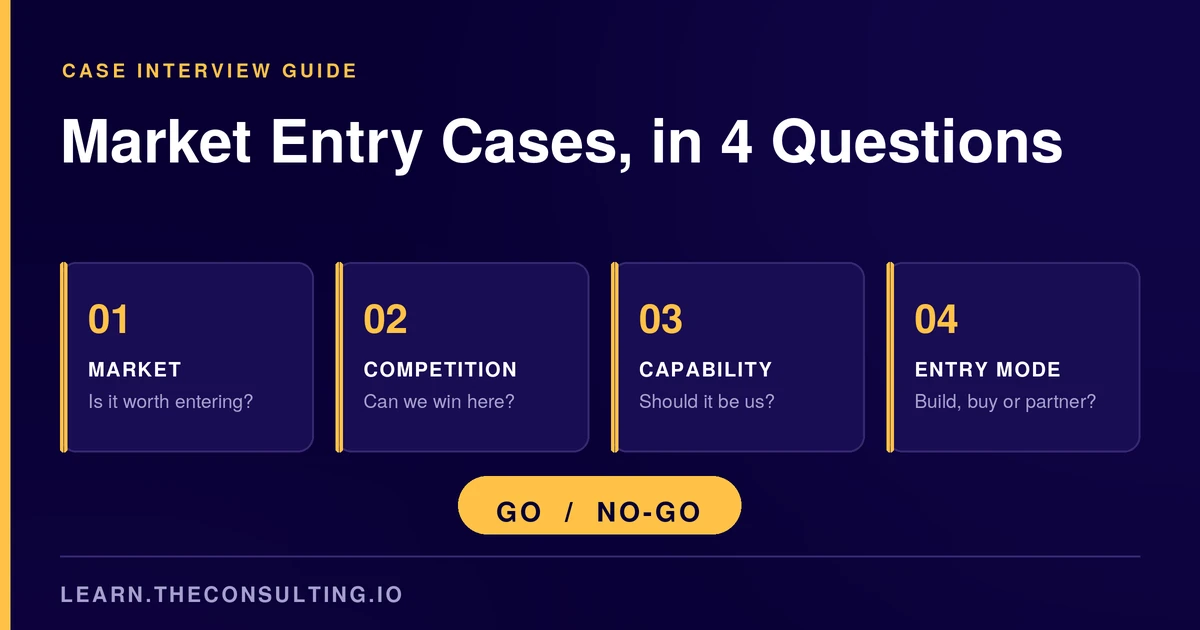
You will hear some version of this prompt in almost every consulting interview loop: our client is thinking about entering a new market, should they do it? It sounds open-ended enough to be frightening, and most candidates respond by listing every factor they can think of until the interviewer gently stops them. The truth is that market entry cases are among the most structured you will face. There are only four questions worth answering, they come in a fixed order, and once you know them the case stops being a memory test and becomes a decision you can actually make.
The four questions
Everything in a market entry case reduces to these, asked in this sequence.
1. Is the market worth entering? Size, growth and profitability. A big market that nobody makes money in is not attractive. A small market with fat margins might be.
2. Can our client win in it? Who is already there, how strong are they, and what would our client do differently.
3. Should our client be the one doing this? Do they have the capability, the capital and the appetite. And what else could they do with the same money.
4. How should they enter? Build from scratch, buy someone already in the market, or partner with them.
Ask them in that order. There is no point debating how to enter a market you have not yet decided is worth entering.
The 5 steps
Step 1: Clarify what counts as entry
Three quick questions before you structure anything.
What exactly does the client sell, and is it the same product in the new market or a modified one? What does entry mean here a new country, a new customer segment, or a new product line? And what is the client actually trying to achieve, because growth, defending a position and testing a new capability all lead to different answers.
Step 2: Size the market
You need a number. Not a precise one, but a number.
Work it out top-down from a population or customer base, narrowed by who would realistically buy. Then ask what the client could plausibly capture. Taking a tenth of a new market within three years is aggressive but defensible. Taking half is not.
Step 3: Study the competition
Find out how concentrated the market is. A handful of large players behaves nothing like a fragmented one.
The question to keep returning to is simple: why would a customer switch to our client. If you cannot answer that, the size of the market does not matter.
Look for barriers too, regulation, distribution access, brand loyalty, switching costs. Barriers that keep others out also keep your client out.
Step 4: Check whether the client can actually do it
This is the step candidates skip, and it is often where the case turns.
Does the client have the capability, or would they be learning on the job? Do they have the capital, and can they survive the years before it pays back? Does anything they already own transfer across: a brand, a supply chain, a customer base? And if they spend this money here, what are they not spending it on.
Step 5: Decide, and say how
Commit to an answer. Then pick an entry route and justify it.
Build it yourself: slowest and most expensive, but you keep everything and control everything. Sensible when the client has time and a real advantage to deploy.
Buy someone already there: fastest, most expensive upfront, and you inherit whatever is wrong with the business you bought. Sensible when speed matters more than cost.
Partner: cheapest and quickest, but you share the upside and depend on someone else. Sensible when the client is uncertain and wants to test before committing.
Worked example: a meal-kit company entering the UK
The prompt. Your client is a US meal-kit delivery business, profitable at home, now considering launching in the United Kingdom. Should they go?
Question 1: Is the market worth entering?
Size it from households.
- UK population: 68 million, roughly 28 million households
- Target households are urban, higher-income, and cook at home call it 20%: 5.6 million households
- Of those, around 8% would realistically use a meal-kit service: 450,000 households
- Average spend: £50 a week, roughly 40 weeks a year, because nobody orders every single week
- Market size: 450,000 × £50 × 40 = about £900 million a year
A market approaching a billion pounds is clearly big enough to be interesting. Say that out loud and move on.
Question 2: Can the client win?
Two established players hold most of the market, with several smaller ones underneath. Both incumbents already have national distribution and brand recognition that took years to build.
So what does our client bring? Their recipe library and supply chain are genuinely strong, but neither is visible to a customer standing in front of a choice. The honest answer is that there is no obvious reason for a UK customer to switch, which means growth would have to be bought through marketing rather than earned through differentiation.
Note that as a concern and carry it forward rather than brushing past it.
Question 3: Should they be the one doing this?
Assume the client targets a 10% share within three years. That is £90 million in revenue.
- Contribution margin: 25%, so £22.5 million
- Annual fixed costs once running distribution centres, staff, overhead: £15 million
- Annual profit at that point: £7.5 million
- Upfront investment two distribution centres plus launch marketing: £40 million
At £7.5 million a year, the £40 million takes more than five years to pay back, and that is only after reaching a 10% share that is itself ambitious given there is no clear reason for customers to switch.
That is the finding. The market is large and the economics are thin.
Question 4: How should they enter?
Building their own distribution network is what makes the numbers fail. It is £40 million of fixed cost in a market where the client has no proven right to win.
Recommendation: partner, do not build. Work with an existing UK grocery delivery operator that already has cold-chain distribution. The client supplies recipes and supply-chain expertise, the partner supplies reach. Upfront investment drops sharply, the payback period shortens, and the client learns whether UK customers actually want their product before committing £40 million to finding out.
The risk: a partner takes a share of the margin, so the ceiling is lower even if it works. And partners can walk away, or copy what they have learned. The next thing to test is whether any credible partner has spare cold-chain capacity, because the whole recommendation rests on that.
That last paragraph is the one that earns the offer. You built a recommendation and then said what could break it.
Four mistakes that cost people the case
Listing everything instead of choosing. Naming fifteen factors is not structure. Pick the four questions and work through them in order.
Never producing a number. A market entry case without a market size is an opinion. Estimate it, state your assumptions, move on.
Skipping the capability question. An attractive market that the client cannot serve is a bad idea, not a good one.
Ending without a decision. You have to say go or no-go. A candidate who summarises both sides and stops has not finished the case.
Practise this one properly
Market entry cases demand estimation and structure at the same time, which is exactly the combination that falls apart under pressure.
Build the four-question structure until it is automatic with Structure Drills, get fast enough at sizing that the arithmetic stops competing with your thinking in Calculation Drills, then run the whole thing end to end in Prep Cases.
Related reading: Pricing Case Interview and Case Interview Math.
Want to stop freezing when a case opens with "should we enter this market"? Start with Structure Drills on TheConsulting.io.