Plenty of strong candidates lose a case not on structure or insight but on a single calculation done slowly, nervously, or wrongly in front of the interviewer. The maths itself is never hard: multiplication, division, percentages and a little growth arithmetic. What makes it difficult is doing it out loud, under time pressure, with someone watching. The fix is a small set of shortcuts you use so often that they become automatic. Below are the nine that cover almost everything a case throws at you, followed by a practice set to time yourself against.
1. Turn big numbers into a number and a count of zeros
Large figures cause most errors because zeros get lost. Write each number as a short figure plus its zeros:
- Thousand = 3 zeros, million = 6, billion = 9
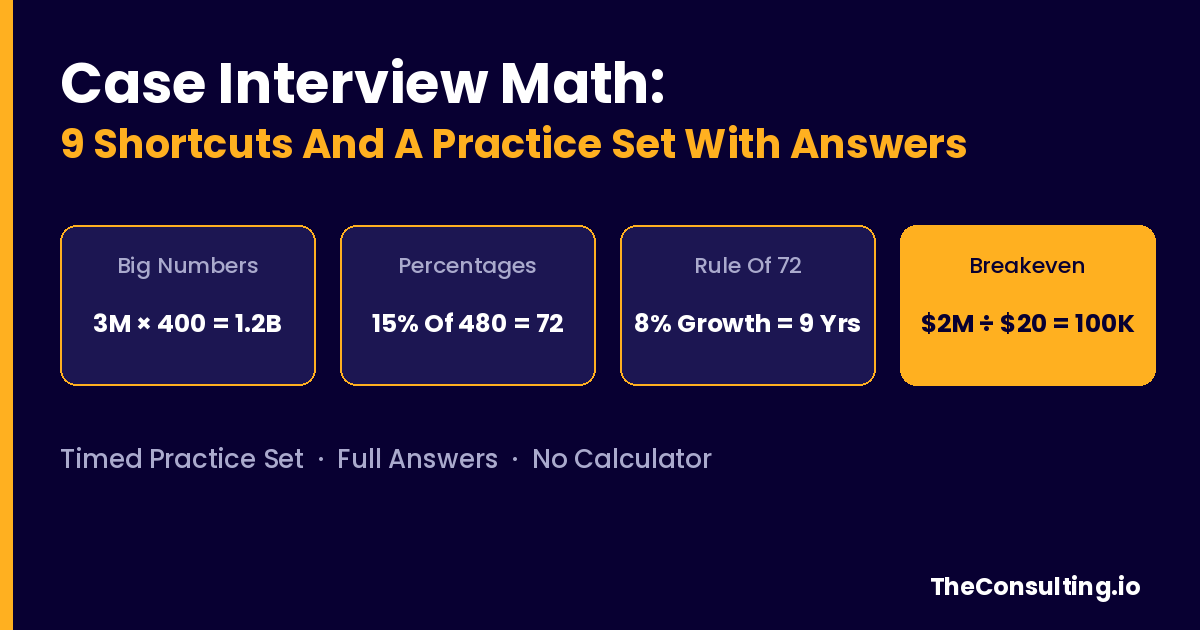
- 3 million × 400 → 3 × 4 = 12, zeros: 6 + 2 = 8 → 12 followed by 8 zeros = 1.2 billion
- 4.5 billion ÷ 300 million → 45 ÷ 3 = 15, zeros: 8 − 8 = 0 → 15
Say the units out loud as you go ("that's 1.2 billion dollars") so the interviewer can follow, and so you catch slips.
2. Round first, adjust later
Exact answers are rarely needed. Round to friendly numbers, then correct if it matters.
- 49 × 21 → 50 × 20 = 1,000. The real answer is 1,029, close enough for most decisions.
- When you round one number up, round the other down to keep the error small.
Tell the interviewer when you're rounding: "I'll use 50 to keep it clean."
3. Flip a percentage when it's easier
x% of y is the same as y% of x.
- 18% of 250 → 250% of 18 → 2.5 × 18 = 45
- 4% of 75 → 75% of 4 = 3
4. Build percentages from 10% and 5%
Find 10% (move the decimal one place), halve it for 5%, and add up the pieces.
- 15% of 480 → 10% = 48, 5% = 24 → 72
- 35% of 1.2 billion → 10% = 120 million, ×3 = 360 million, plus 5% = 60 million → 420 million
5. Know the awkward fractions by heart
Dividing by 7 or 12 in your head is slow. Converting to a percentage is quick.
| Fraction | Percentage |
|---|---|
| 1/3 | 33.3% |
| 1/6 | 16.7% |
| 1/7 | 14.3% |
| 1/8 | 12.5% |
| 1/9 | 11.1% |
| 1/11 | 9.1% |
| 1/12 | 8.3% |
2,400 ÷ 7 → 2,400 × 14.3% ≈ 343
6. Percentage change, and the reversal trap
Change = (new − old) ÷ old
- Profit rises from $80 million to $92 million → 12 ÷ 80 = 15% growth
The trap: a 20% drop followed by a 20% rise does not get you back to where you started. 100 → 80 → 96, a net 4% loss. Interviewers like to test this when a client "recovered" after a bad year.
7. The rule of 72 for growth
To find how long something takes to double, divide 72 by the growth rate.
- 8% a year → 72 ÷ 8 = 9 years to double
- 6% a year → 12 years
For short periods, compounding is close to simple addition plus a little extra: 10% a year for 3 years is about 33% total, not 30%.
8. Breakeven and payback in one line each
Breakeven units = fixed costs ÷ (price − variable cost per unit)
- Fixed costs $2 million, price $50, variable cost $30 → $2 million ÷ $20 = 100,000 units
Payback period = upfront investment ÷ yearly savings or profit
- Spend $3 million to save $750,000 a year → 4 years
These two come up in almost every investment or new-product case.
9. Margin is not markup
Both compare price and cost, but against different bases.
- Cost $60, price $100
- Margin = profit ÷ price = 40 ÷ 100 = 40%
- Markup = profit ÷ cost = 40 ÷ 60 = 67%
To price at a target margin: price = cost ÷ (1 − margin). A $40 cost at a 20% margin → 40 ÷ 0.8 = $50.
Confusing the two is one of the quickest ways to undermine an otherwise good answer, so always check which one the interviewer means.
How to do the maths out loud
The interviewer is scoring how you calculate as well as the answer:
- Say the setup first: "Revenue is users times price, so 3 million times $400."
- Write as you go, in a neat column, so you can find any slip.
- Label the result with units and meaning: "So that's $1.2 billion a year."
- Ask whether it makes sense: "That's about 5% of the whole industry, which seems reasonable."
Practice set: time yourself
Aim for under 60 seconds each, out loud, with no calculator. Answers are below.
- What is 35% of 1.2 billion?
- What is 7.2 million ÷ 1,800?
- Revenue grows 6% a year. Roughly how long until it doubles?
- Fixed costs are $900,000, the price is $120 and the variable cost is $75. What's the breakeven volume?
- What is 2,400 ÷ 7, roughly?
- A client has 12% of a $45 billion market. What are its revenues?
- Profit rose from $8 million to $10 million. What's the growth rate?
- A product costs $40. What price gives a 20% margin?
Answers
- 420 million (10% = 120 million, ×3, plus 5% = 60 million)
- 4,000 (72 ÷ 18 = 4, zeros: 5 − 2 = 3)
- About 12 years (72 ÷ 6)
- 20,000 units ($900,000 ÷ $45)
- About 343 (2,400 × 14.3%)
- $5.4 billion (10% = 4.5, plus 2% = 0.9)
- 25% (2 ÷ 8)
- $50 (40 ÷ 0.8)
Score 7 or 8 inside the time limit and you're ready. Below 6, practise a set like this daily for a week. The improvement comes quickly.
Keep it sharp
Mental maths fades without practice, so short daily sets beat one long session the week before an interview.
Run timed Calculation Drills to build speed, use the maths inside full Prep Cases, and practise calculating out loud in a Peer-to-Peer Session.
Freeze when the numbers get big? Train it away with TheConsulting.io's Calculation Drills, or see the plans.