
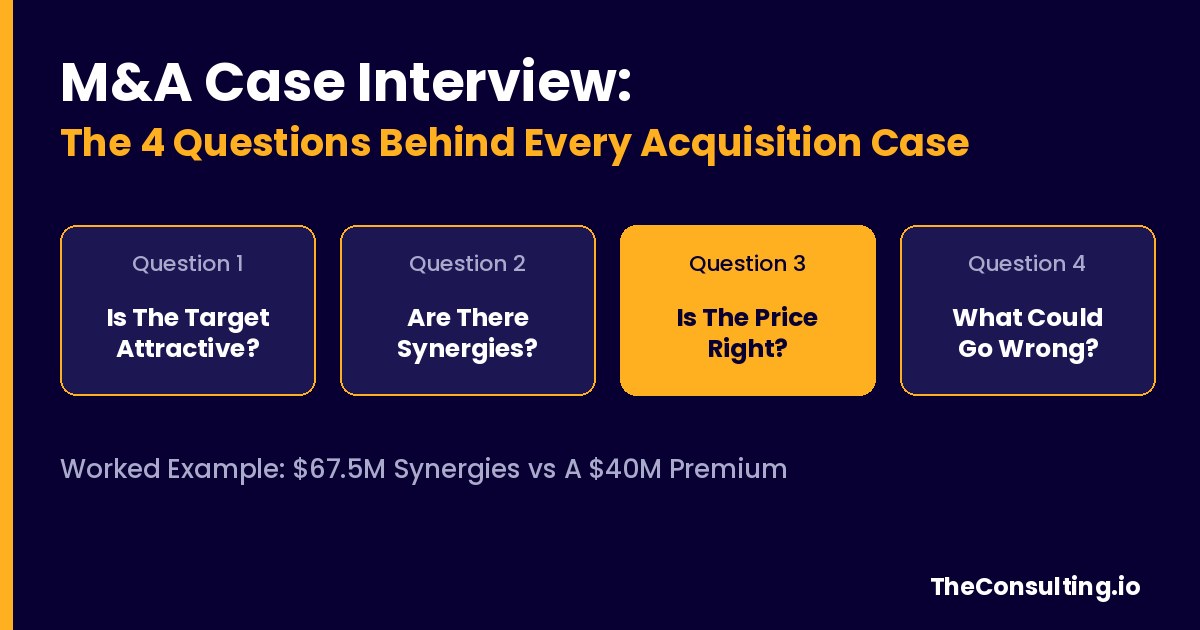
"Our client is thinking about buying another company. Should they do it?" M&A cases sound intimidating because they borrow the language of bankers and dealmakers, but in an interview they boil down to a short chain of questions any careful buyer would ask before spending a lot of money. Is the company worth owning? Is it worth more to us than to anyone else? Is the price fair? What could go wrong? This guide explains each of the four questions, shows how to value synergies without any finance training, and solves a complete acquisition case with the numbers worked out.
Why companies buy other companies
Before structuring, ask what the client is trying to achieve. The reason shapes everything that follows.
- Growth: entering a new market, region or customer group faster than building it themselves
- Capabilities: gaining technology, talent or a brand they lack
- Cost savings: combining operations to buy, produce or run more cheaply
- Defence: stopping a competitor from getting the asset
- Financial return: for private equity buyers, buying, improving and selling at a profit
A strategic buyer (a company in the industry) and a financial buyer (an investment fund) ask the same four questions, but a financial buyer cares mainly about return and exit, not fit.
The 4 questions
1. Is the target attractive on its own?
Look at the target as if no deal were happening:
- Is its market large and growing?
- Is it profitable, and is that profit stable or slipping?
- Does it have a real advantage, such as a brand, loyal customers, technology or locations?
- Are there problems hiding underneath, such as falling sales, customer concentration or ageing assets?
2. Is it worth more with us than alone? (Synergies)
Synergies are the extra value created by combining the two companies. There are two kinds:
- Cost synergies: shared purchasing, merged head offices, combined logistics. These are fairly predictable.
- Revenue synergies: selling each other's products to each other's customers, or using one company's channels to sell the other's products. These are less certain, so interviewers expect you to discount them.
A useful rule: count cost synergies close to in full, and count only around half of revenue synergies.
Don't forget the one-off cost of integration: systems, rebranding, redundancies, moving offices.
3. Is the price right?
You don't need finance theory. Use a simple multiple:
Standalone value = target's yearly profit × the multiple similar companies sell for
Then compare:
- If the asking price is above standalone value, the buyer is paying a premium.
- The deal only makes sense if the value of synergies, minus integration costs, is bigger than that premium.
4. What could go wrong, and how should we do it?
- Integration risk: different cultures, systems and processes that don't merge smoothly
- Customer or staff loss: key people or customers leaving after the deal
- Regulatory risk: competition authorities blocking or delaying it
- Alternatives: could the client get the same benefit through a partnership, a licence or building it themselves?
Worked example: a coffee chain buying a bakery-café chain
The prompt: Our client is a large US coffee chain. It's considering acquiring a regional bakery-café chain with 150 locations for $240 million. Should it?
Clarify the goal: The client wants to grow its food sales. Its stores sell coffee well, but food is weak.
Question 1: Is the target attractive?
| Metric | Target |
|---|---|
| Locations | 150 |
| Annual revenue | $200M |
| Annual profit (before interest and tax) | $20M |
| Growth | About 6% a year, slightly above the market |
A healthy, growing business with a strong food reputation, which is exactly what the client lacks.
Question 2: What are the synergies?
Cost synergies:
- Joint purchasing of ingredients, packaging and equipment: $4M a year
- Merged back office (finance, HR, IT): $2M a year
- Total: $6M a year, counted in full
Revenue synergies:
- The client's coffee sold in the target's 150 cafés: about $100,000 of extra sales per café → $15M a year
- At a 30% margin, that's $4.5M of extra profit
- Revenue synergies are uncertain, so count half → $2.25M a year
Total synergies counted: about $8.25M a year
One-off integration cost: about $15M
Question 3: Is the price right?
Similar café chains sell for about 10 times yearly profit.
- Standalone value: $20M × 10 = $200M
- Asking price: $240M → premium of $40M
- Value of synergies: $8.25M × 10 = $82.5M
- Minus integration cost: $82.5M − $15M = $67.5M net synergy value
$67.5M of extra value comfortably covers a $40M premium. The deal creates about $27.5M of value for the client at this price.
The walk-away price: $200M + $67.5M ≈ $267M. Above that, the client would be handing all the synergy value to the seller.
Question 4: Risks
- The revenue synergy depends on bakery customers wanting the client's coffee, which is worth testing in a handful of cafés first.
- The target's food expertise sits with its kitchen and operations staff, so retention packages matter.
- At 150 locations in one region, regulatory risk is low.
The recommendation
"I'd recommend the acquisition at $240 million. The target is profitable and growing, and it fills the client's biggest gap, food. Even counting only half the revenue synergies, combining the two creates about $67 million of net value, well above the $40 million premium being paid. I'd set a walk-away price of around $265 million, test coffee sales in a few cafés during due diligence, and put retention plans in place for the target's kitchen leadership."
Spotting an M&A case early
Listen for these words in the opening prompt: acquire, buy, merge, take a stake, invest in, partner with, private equity, due diligence. Each one signals that the four questions above should shape your structure, with more emphasis on synergies for a company buyer and on return and exit for a fund.
Practise deal decisions
M&A cases reward a clear structure and calm, simple maths. Both improve quickly with repetition.
Sharpen structuring and valuation maths with Drills, work through acquisition problems in Prep Cases, and defend a deal recommendation live in a Peer-to-Peer Session.
Could you call a $240 million deal in 25 minutes? Find out with TheConsulting.io's Prep Cases, or see the plans.


