In a pricing case, you are asked what a company should charge. There are only three ways to answer: price from your costs, price from what competitors charge, or price from the value the customer receives. Costs set your floor, competitors set your anchor, and value sets your ceiling. Strong candidates work through all three, then commit to one number and explain which approach drove it.
What A Pricing Case Actually Tests
Interviewers like pricing cases because they expose three things at once: whether you can structure a problem, whether your arithmetic holds up while you are talking, and whether you will actually commit to an answer.
The last one catches most people. Candidates build a beautiful range and then refuse to pick a number. A range is not a recommendation, you have to be specific. Your client cannot put a range on a price tag.
The Three Shapes A Pricing Case Takes
As the whole case. "Our client has developed a new product. What should they charge?" You get 25 to 35 minutes and you are expected to reach a specific price.
As one part of a bigger case. A market entry case where you need a price before you can size the opportunity. A profitability case where the real problem turns out to be discounting.
As a quick standalone question. "How would you price a new drug?" Five minutes, no data, pure structure.
There is also a fourth version that catches people out: instead of setting a price, you are asked to evaluate a price change. That one runs on different mechanics, and it gets its own section further down.
The Three Ways To Price Anything
1. Cost-Based Pricing — Your Floor
Work out what it costs to make one unit, add a margin, and that is your price.
Price = full cost per unit ÷ (1 − target margin)
Full cost means variable cost plus an allocation of fixed costs. Forgetting the fixed cost allocation is the single most common arithmetic error in these cases, and it makes your floor look lower than it is.
Cost-based pricing is the easiest number to reach, which is exactly why reaching for it first looks weak. It ignores everything the customer thinks and everything competitors are doing. A product that costs $10 to make might be worth $500 to the buyer, and cost-based pricing will never discover that.
Use it as: your floor. Never your answer.
2. Competitor-Based Pricing — Your Anchor
Look at what comparable products sell for and price relative to them: above if you are better, below if you are cheaper to run, level if you are similar.
The trap is deciding what counts as a competitor. If your client sells a machine that removes the need for two workers, the real competitor is not another machine. It is the cost of employing two people.
So ask this instead of "who are the competitors": what does the customer do today if this product does not exist? Sometimes the answer is "hire someone." Sometimes it is "accept the losses." That is your real comparison.
Use it as: your reality check on what the market will bear.
3. Value-Based Pricing — Your Ceiling
Work out what the customer gains in money terms, then capture a share of that gain.
This is the one interviewers want to hear and the one most candidates skip. It is the only approach that starts from the customer instead of the seller.
How to run it:
- Identify what the customer currently does instead
- Work out what that alternative costs them per year
- Work out what your product saves or earns them per year
- Multiply by how long they will use it
- Price at a share of that total — typically a fifth to a third, so the customer keeps a visible benefit
That last point matters. If you price at the exact value delivered, the customer gains nothing by buying and will not switch.
Use it as: your answer, checked against the other two.
The 5 Steps
Step 1 — Ask what kind of product this is. New to the world, or a version of something that already exists? A genuinely new product has no comparison price, so value-based is your only real option. A me-too product is mostly a competitor-pricing question.
Step 2 — Ask about the objective. Maximise profit now, or take share fast and make money later? These give completely different answers, and interviewers often leave it vague on purpose to see whether you ask.
Step 3 — Work through all three approaches. Say all three out loud. Calculate the ones you have data for. This is the part that separates a structured candidate from someone guessing.
Step 4 — Pick your number and say why. Commit, and name which approach drove it.
Step 5 — Test it. Does it clear the cost floor? Is it credible against competitors? Does the customer still gain enough to switch? Then say what would break it.
Case Study Example: Pricing An Industrial Sensor
The Case prompt. Your client is a manufacturer that has developed a sensor for factory equipment. It predicts machine failures before they happen. Nothing quite like it exists on the market. What should they charge?
Before you read on, try it yourself. Take two minutes, sketch the three approaches, and write down a number. Then compare. You will learn more from being wrong here than from reading the answer cold.
Step 1: The Cost Floor
- Variable cost to produce one sensor: $40
- Fixed costs (development, tooling, overhead): $2 million a year
- Expected volume: 100,000 units a year
- Fixed cost per unit: $2,000,000 ÷ 100,000 = $20
- Full cost per unit: $40 + $20 = $60
At a 30% target margin: $60 ÷ 0.70 = about $86.
Say this out loud as you write it: "That's a floor, not an answer. It tells me nothing about what a customer would pay."
Step 2: The Competitor Check
The closest comparable product is a basic monitoring device selling at $95. But it only reports failures after they happen — it does not predict them.
So $95 anchors the low end of the market, and our client's product does something meaningfully different. Note the anchor, then move past it.
Step 3: The Value To The Customer
This is where the case is won.
- An unexpected machine failure shuts a production line down for about 8 hours
- Lost output costs the customer roughly $150 an hour
- Cost of one failure: 8 × $150 = $1,200
- A typical factory has about 2 unexpected failures a year on this equipment
- Annual cost of failures: $2,400
- The sensor prevents roughly half of them: $1,200 saved per year
- The sensor lasts 3 years
- Total value delivered: $3,600
At a fifth to a third of value captured, that supports a price of $720 to $1,200.
Step 4: The Recommendation
Three approaches, three very different numbers:
| Approach | Price | What it tells you |
|---|---|---|
|
Cost-based |
$86 |
The floor |
|
Competitor-based |
$95 |
What the market is used to |
|
Value-based |
$720 – $1,200 |
What it is actually worth |
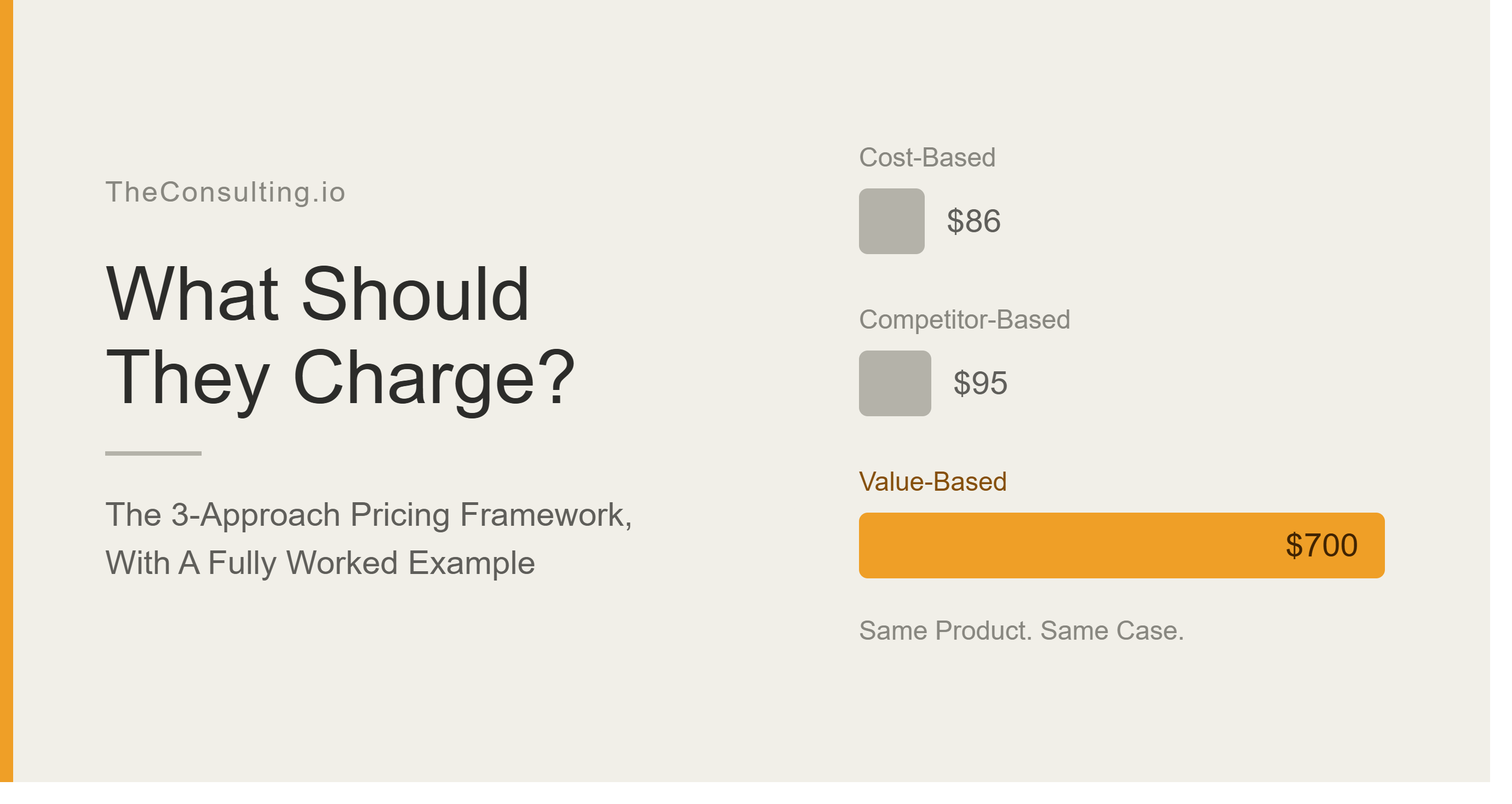
The gap is enormous, and it is the entire point of the case. Cost-based pricing would have thrown away more than 90% of the available value.
Recommend launching at $700. That sits just under a fifth of total value — deliberately at the bottom of the range. It does three useful things: it leaves the customer an obvious payback, it makes the jump from a $95 anchor easier to swallow, and it leaves headroom to raise prices once the product proves itself.
Check the profit. At $700, contribution per unit is $700 − $40 = $660. Across 100,000 units that is $66 million, less $2 million of fixed costs, giving $64 million a year. Compare with cost-based pricing at $86: contribution of $46 a unit, $4.6 million total, $2.6 million of profit. The pricing decision alone is worth roughly twenty-five times more than the manufacturing decision.
Name the risk. Buyers anchored to a $95 device may reject $700 on sight, whatever the arithmetic says. The next thing to test is a pilot with a handful of customers, measuring failures actually prevented, so the client walks into the price conversation with evidence rather than a model.
A Good Answer Vs A Better Answer
A good answer reaches $700 through the three approaches and explains that value-based pricing drove it.
A better answer does that, then adds the two things above: it quantifies what the pricing decision is worth against the alternative, and it names the specific thing that could break the recommendation along with how to test it.
That second half is what earns the offer. You built a case for a number and then said what could go wrong with it.
What If You Are Asked To Evaluate A Price Change Instead?
Roughly a third of pricing cases are not "what should we charge" but "should we raise or cut what we already charge." These run on price elasticity — how much volume moves when price moves.
The rule: if volume falls by less than 1% for every 1% price rise, demand is inelastic and raising prices grows profit. If it falls by more, the increase backfires.
Quick example. A gym chain charges $40 a month, has 20,000 members, and spends $10 per member per month in variable costs. It is considering a 15% increase to $46, and research suggests membership would drop 10%.
- Elasticity: 10% ÷ 15% = 0.67 — inelastic, so the hypothesis is that this works
- Today: ($40 − $10) × 20,000 = $600,000 a month
- After: ($46 − $10) × 18,000 = $648,000 a month
The increase adds $48,000 a month, an 8% gain that flows almost entirely to profit because fixed costs do not move. Recommend the rise, then monitor cancellations for the first quarter in case members turn out to be more price-sensitive than the research says.
Four Common Mistakes To Avoid
Answering with cost-based pricing. It is the easiest number to reach, which is exactly why leading with it looks weak. Mention it as a floor and move on.
Defining competitors too narrowly. Ask what the customer does today if this product does not exist.
Forgetting how long the product lasts. Value per year is not value. Multiply by lifetime.
Capturing all the value. Price at the exact value delivered and the customer has no reason to buy. Always leave a visible benefit on their side.
How To Practise This Properly
Pricing cases reward speed with numbers, because the value calculation runs several steps deep and you have to hold it together while talking. Practising the framework on paper is not the same as running it out loud against a clock.
- Calculation Drills — get fast enough that the arithmetic stops competing with your thinking
- Structure Drills — build the three-approach structure until it is automatic
- Prep Cases — full cases with pricing built in
- Peer-to-Peer Practice — say it to a person who will challenge your assumptions
Ready to practise? Run timed drills and full cases at TheConsulting.io.